
AstraZeneca-BMS Merger Cancelled
Exploring the Pax Pharmaceutica that never arrived

Disclaimer: This newsletter is for educational and informational purposes only and does not constitute medical, investment, or financial advice, nor does it establish a provider-patient relationship. Content may include forward-looking statements and discussions of investigational therapeutic candidates that are not FDA/EMA approved; their safety and efficacy remain unestablished and clinical outcomes are unpredictable. While we strive for accuracy, all information is provided as is without guarantees. As of the date of publication, the author holds no direct equity positions in the specific companies mentioned in this issue nor receives third-party compensation for this coverage. Please find a complete version of our disclaimers at the bottom of this article and on our About page.

Introduction
On August 2, 2026, the Financial Times reported that two big pharma companies, AstraZeneca and Bristol Myers Squibb, “held discussions about a tie-up in recent months, according to people familiar with the matter”. Three days later on August 5, 2026, Reuters threw cold water on the theorized mega-merger, reporting that “there are no discussions ongoing between AstraZeneca and Bristol Myers Squibb over a potential deal, [according to] a senior source close to the matter”.
Mega-merger cancelled.
This got me thinking: what would the world look like if the merger actually went through?
In this article, we discuss the central challenge of every big pharma CEO and imagine what the world would look like if AstraZeneca and Bristol Myers Squibb had indeed merged.
The Sun That Never Sets
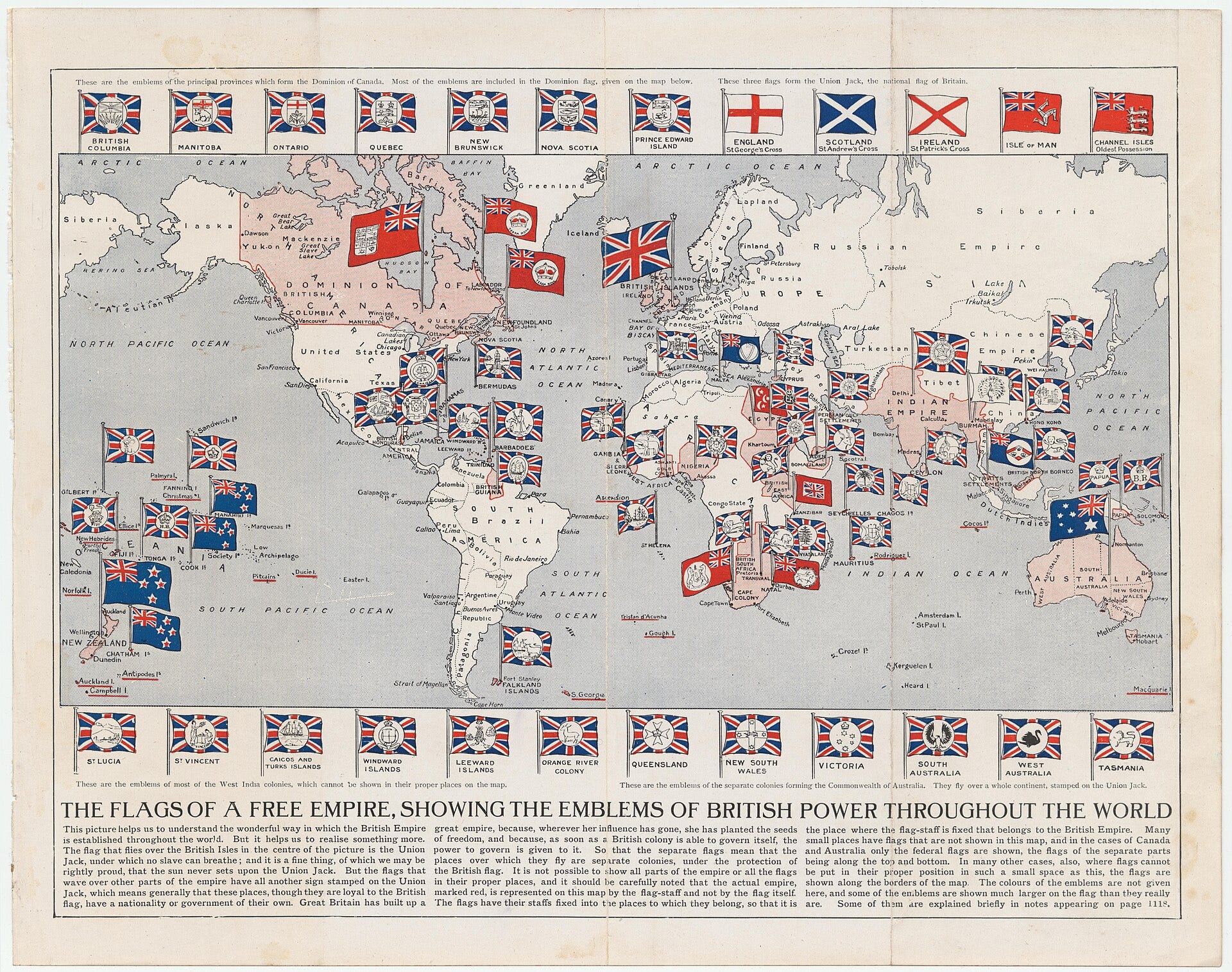
If history has taught us anything, it’s that even the most formidable empires can fall as quickly as they rise. Over the past two millennia, various empires competed with one another until the British Empire reached its territorial apex in 1920. This remains the largest continuous or non-contiguous empire by total land area in human history, covering roughly 25% of the Earth’s total land surface and encompassing about 23% of the global population at the time.
.jpg)
Ironically, this territorial high-water mark occurred just as the Pax Britannica (Latin for “British Peace”) was structurally weakening. During the early 19th century, Britain was the unchallenged workshop of the world. However, by the late 1800s, rapid second-stage industrialization in Germany and the United States began outpacing British steel, chemical, and heavy manufacturing output. World War I severely drained British financial reserves, turning London from a primary global creditor into a nation heavily indebted to the United States. The seamless global free-trade system organized around the pound sterling disintegrated as wartime blockades, tariffs, and inflation disrupted global commerce. Independence movements across India, Ireland, and the Middle East accelerated rapidly during the 1920s. By 1941, Britain was virtually bankrupt. To secure American military supplies, Britain was forced to sign agreements like Lend-Lease and agree to the Atlantic Charter (1941), which pledged post-war self-determination for colonies and open global trade, effectively dismantling the British imperial preference system. The 1944 Bretton Woods Conference officially established the U.S. Dollar (backed by gold) as the world’s primary reserve currency, replacing the British Pound Sterling.
Just as the Pax Britannica fell, the Pax Americana (Latin for “American Peace”) rose to take its place. Following the end of World War II in 1945, the economic, military, political, and cultural hegemony of the United States defined the new world order. The final straw arrived in the 1956 when Britain, France, and Israel invaded Egypt to retake the Suez Canal. Under severe financial and diplomatic pressure from U.S. President Dwight D. Eisenhower, who threatened to collapse the British pound, Britain was forced into a humiliating withdrawal, demonstrating to the world that no major British geopolitical action could occur without explicit American backing.
Much like the changing world order, big pharma companies must race against patent cliffs to maintain a portfolio of cutting-edge medicines that keep sales aloft; a Pax Pharmaceutica if you will.
In the pharmaceutical industry, a patent cliff refers to the sharp, sudden drop in revenue a pharmaceutical company experiences when the patent protection on its highly profitable blockbuster drugs (drugs generating >$1 billion in annual sales) expires. Once this market exclusivity lapses, cheaper generic or biosimilar alternatives can enter the market. This exposes the original drug maker to intense competition and breaks its monopolistic pricing power. Unlike a slow transition, a patent cliff can trigger a 30% to 90% drop in brand revenue within the very first year of generic competition. Multi-billion-dollar revenue streams shift away from the innovator firm and directly benefit generic manufacturers, insurance payers, and patients through drastically lower prices.
An excerpt from China Biotech: Feast or Famine? by Biotech Readout
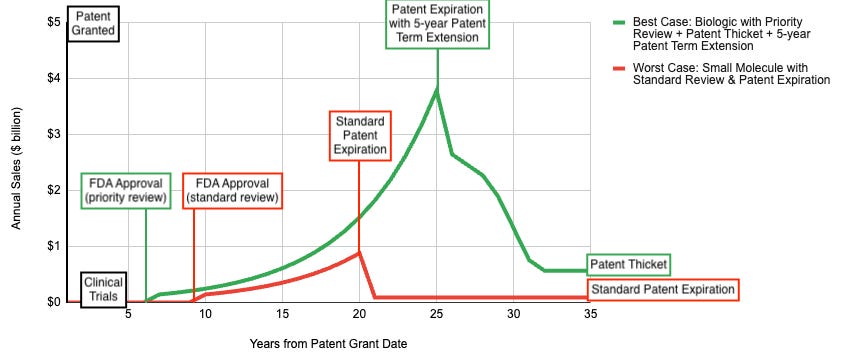
In the 16th century, King Charles V of the Holy Roman Empire remarked, “In my realm, the sun never sets.” (Spanish: “En mis dominios no se pone el sol.”). This is the central challenge of every big pharma CEO: to develop or acquire new & better medicines faster than the older medicines tumble over their patent cliffs, thereby ensuring that the sun never sets on their empire.
The Big Fish Eat Other Big Fish
Pascal Soriot, CEO of AstraZeneca, and Chris Boerner, CEO of Bristol Myers Squibb are both running this race. The now-debunked the Financial Times report would have you believe that these two big pharmas were closing in on a mega-merger.
When a patent cliff is too steep to fight off with legal maneuvers alone, pharmaceutical companies can use their massive cash reserves to buy out the very companies, platforms, or specific assets that can immediately replace eroding revenue. This can involve buying out smaller biotech firms with a few medicines in their pipeline (called “bolt-on acquisitions”) or a mega-merger with a large, diversified pipeline.
An excerpt from China Biotech: Feast or Famine? by Biotech Readout
Let’s take a step back and opine on the grand irony of the AZ-BMS situation: both AstraZeneca (AZ) and Bristol Myers Squibb (BMS) were themselves born out of mega-mergers.
Founded in 1913 by Swedish apothecaries and physicians, Astra grew into a Scandinavian pharmaceutical power. By the late 1990s, Astra’s core engine was its mega-blockbuster GI drug Prilosec (omeprazole), the world’s best-selling prescription drug at the time, along with a strong respiratory and local anesthetic portfolio. Zeneca was formed in 1993 when British industrial giant Imperial Chemical Industries (ICI) demerged its pharmaceutical, agrochemical, and specialty chemical units. Zeneca held a world-class oncology portfolio featuring targeted cancer treatments like Nolvadex (tamoxifen) and the ACE inhibitor Zestril (lisinopril). Astra faced an existential revenue cliff as Prilosec neared its US patent expiration in the early 2000s. Merging with Zeneca diversified its cash flows immediately. Astra’s commercial strength in North America paired cleanly with Zeneca’s deep distribution networks in Europe and emerging markets. In December 1999, the two companies announced a cross-border “merger of equals”, which was completed in April 1999. The resulting AstraZeneca was valued at approximately $67 billion, with Zeneca shareholders receiving 53.5% of the new entity, while Astra shareholders retained 46.5%. The combined entity created the world’s 4th-largest pharma company at the time, establishing deep domain authority across gastrointestinal, cardiovascular, oncology, and respiratory disease.
Bristol Myers Squibb’s path was similar but different. Tracing its origins back to 1887 in Clinton, NY, Bristol-Myers was a diversified healthcare and consumer giant. While it maintained prescription pharmaceutical franchises, particularly early chemotherapy agents, a large portion of its revenue came from household products (Windex, Drano via Drackett), hair care (Clairol), and infant nutrition (Mead Johnson). Founded in 1858 in Brooklyn by Dr. Edward Robinson Squibb, the eponymous company Squibb was an early pioneer in pharmaceutical quality control and the leading producer of penicillin during WWII. By 1989, Squibb was powered by Capoten (captopril), the first-in-class ACE inhibitor that revolutionized hypertension therapy. The friendly union was partly structured to preempt hostile overseas takeovers, most notably preventing Britain’s Glaxo from acquiring Squibb. The mega-merger was completed in July 1989 to form, Bristol Myers Squibb, the 2nd-largest pharmaceutical company in the world behind only Merck & Co., boasting combined revenues of $8.6 billion. Following the merger, Bristol Myers Squibb systematically divested its non-pharma consumer goods divisions (such as selling Drackett to S.C. Johnson) to redeploy capital into high-margin, innovation-driven prescription drug R&D.
The resulting pharmaceutical behemoths remained acquisitive, having purchased at least 30 companies for more than $200 billion in total deal value (see graph below).
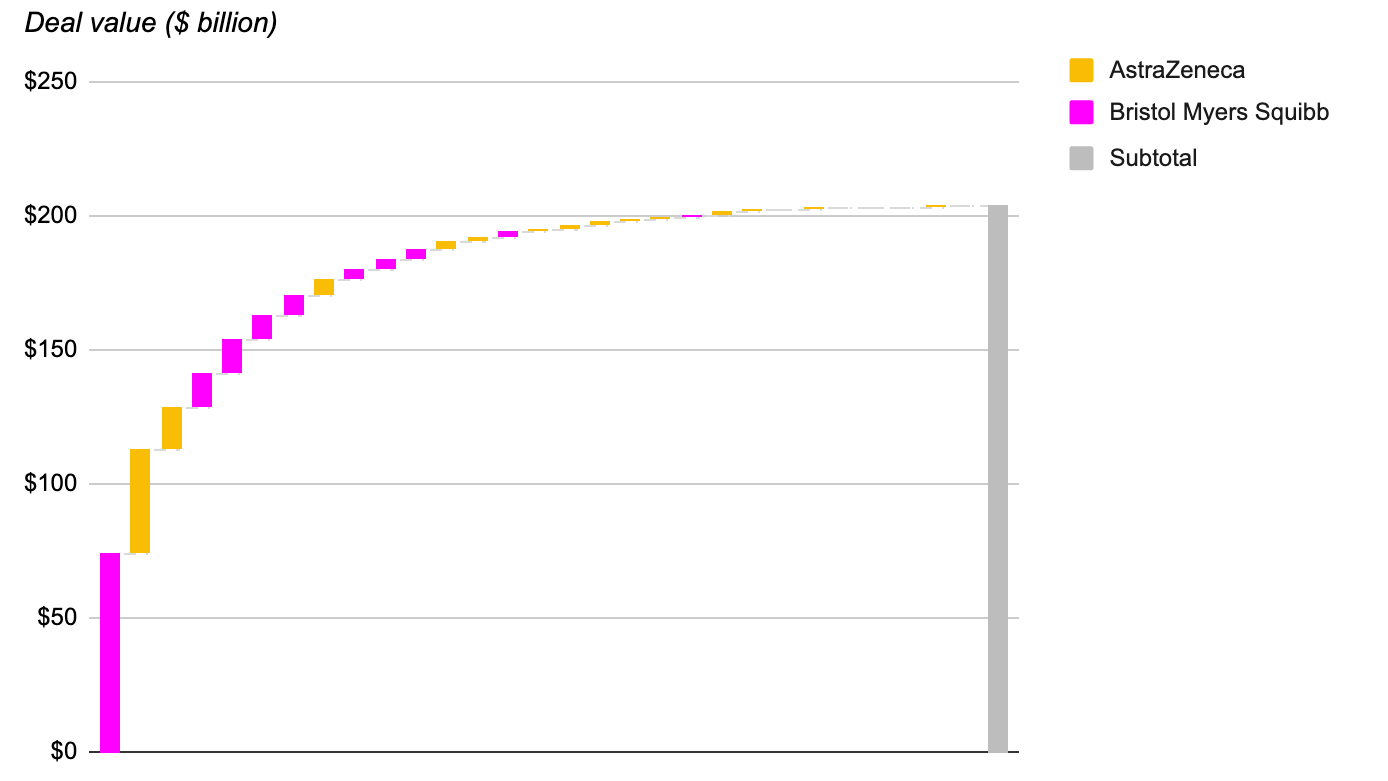
These include two of the largest and most strategically decisive mega-mergers in modern biotech history:
Bristol Myers Squibb’s Acquisition of Celgene ($95 billion): This deal was announced in January 2019 and closed in November 2019. Celgene brought the undisputed gold-standard immunomodulatory drugs (IMiDs) for multiple myeloma, Revlimid (lenalidomide) and Pomalyst (pomalidomide), alongside a leading pipeline of autologous CAR-T cell therapies (yielding Abecma and Breyanzi). To secure FTC antitrust clearance due to overlap in psoriasis treatments, BMS was forced to divest Celgene’s immunology blockbuster Otezla (apremilast) to Amgen for $13.4 billion before the deal could close.
AstraZeneca’s Acquisition of Alexion Pharmaceuticals ($39 billion): The deal was announced in December 2020 and closed in July 2021. Before this acquisition, AstraZeneca had little presence in rare diseases. Alexion was the undisputed leader in complement biology, anchored by its blockbusters Soliris (eculizumab) and its long-acting successor Ultomiris (ravulizumab). While AstraZeneca’s oncology engine (Tagrisso, Imfinzi, Enhertu) was growing rapidly, adding Alexion provided immediate, non-dilutive, high-margin cash flows to fund ongoing clinical development.
All Talk, No Walk
This brings us back to the “talks” reported by the Financial Times and now debunked by the Reuters report. As of today, it appears that AstraZeneca and Bristol Myers Squibb are not merging. But, what if they did merge?
The resulting MergeCo between AstraZeneca & Bristol Myers Squibb would become the 4th largest pharmaceutical company by enterprise value (see graph below).
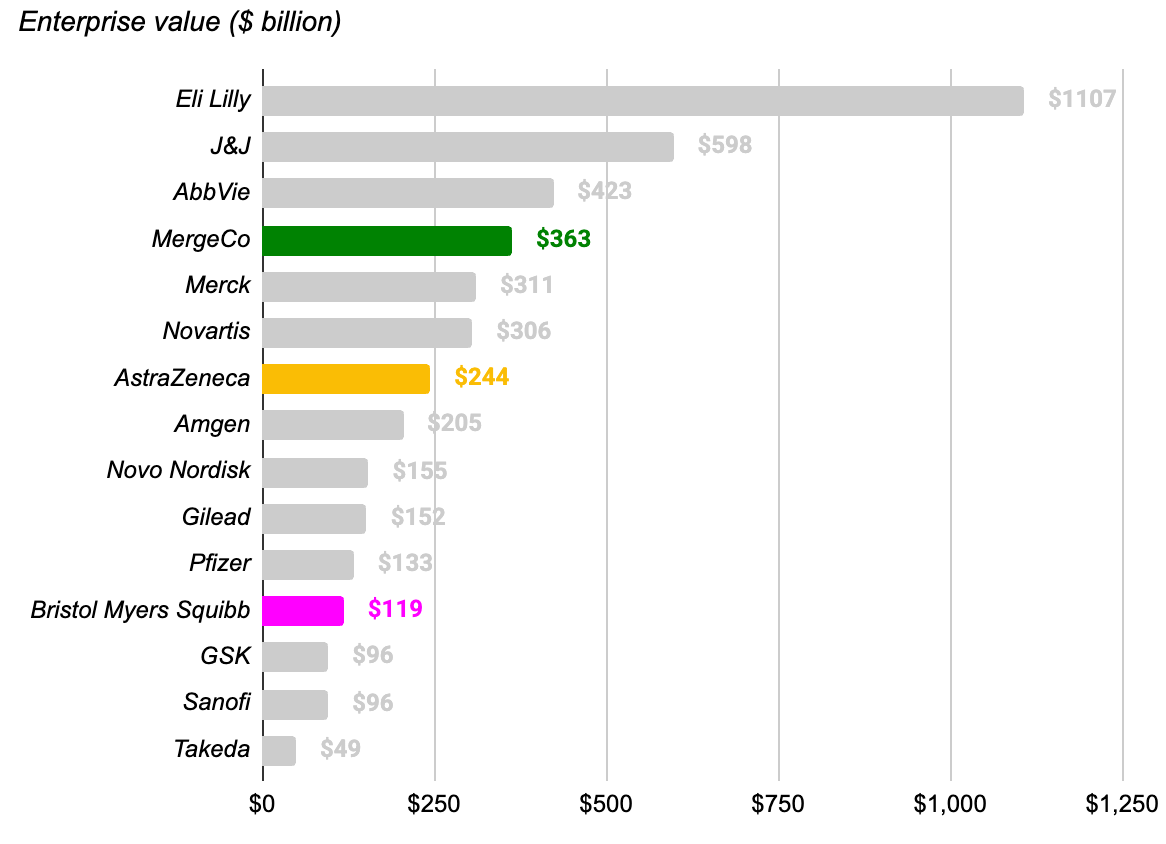
BMS’ cardiovascular and immuno-oncology heavyweights Eliquis and Opdivo would complement AstraZeneca’s blockbuster franchises in solid tumors (Tagrisso, Enhertu, Lynparza) and I&I (Ultomiris, Fasenra, Soliris).
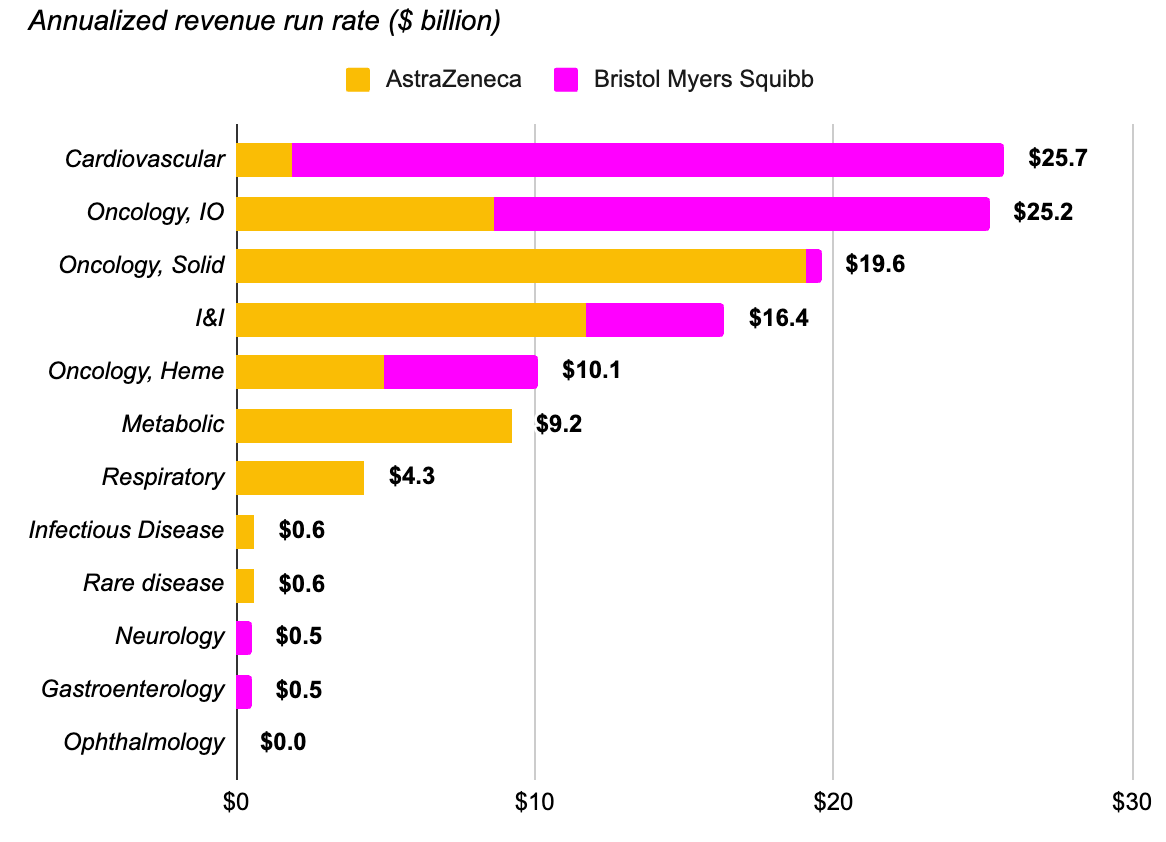
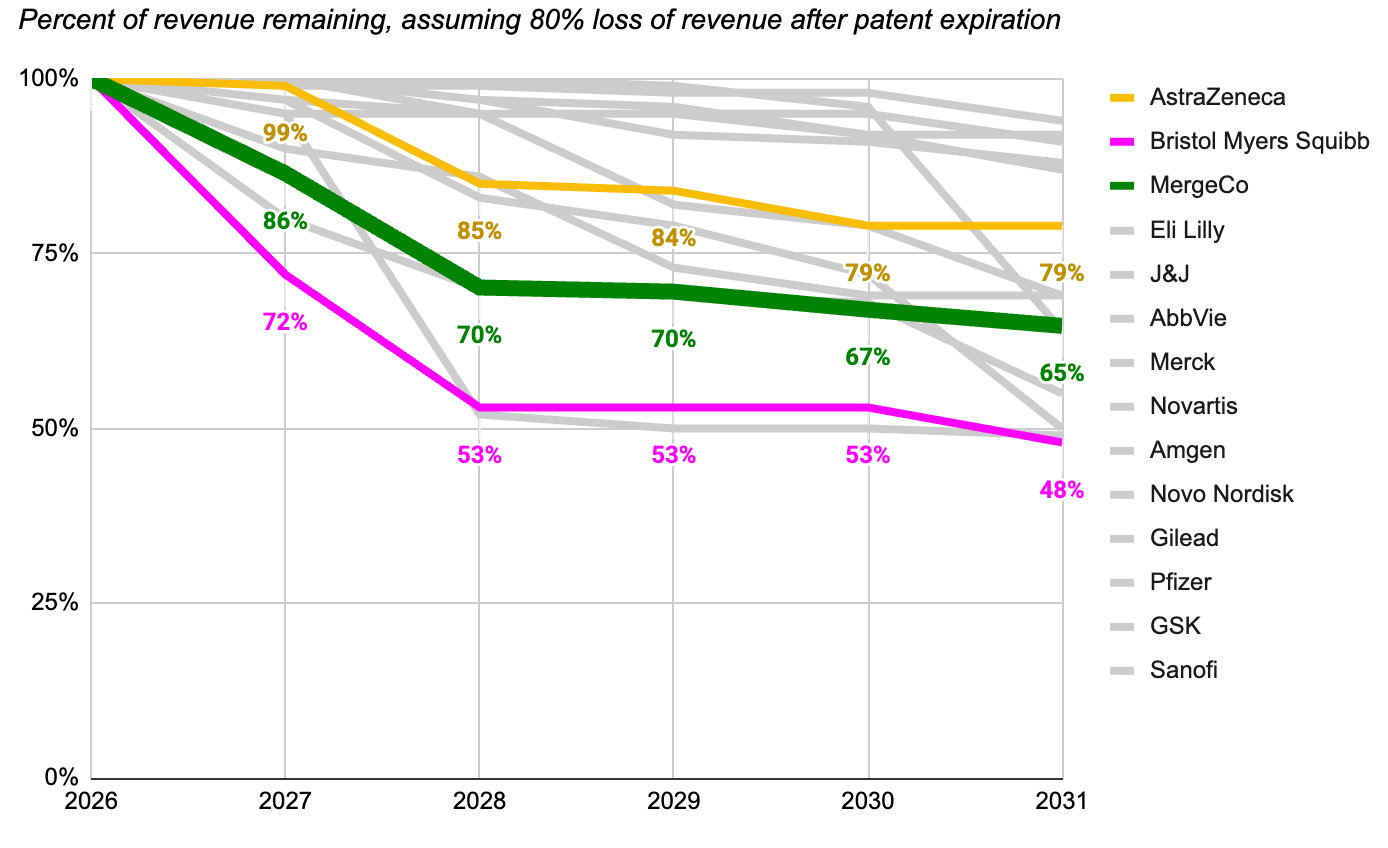
While AstraZeneca’s patent cliff appears relatively shallow, Bristol Myers Squibb’s patent cliff appears much steeper with 48% of revenue remaining after 5 years, assuming each genericized drug sees an 80% loss of revenue after patent expiration. The combined MergeCo would meaningfully raise BMS’ patent cliff from 48% to 65% of intact revenue after 5 years. Note that this model likely exaggerates the true size of their respective patient cliffs, as it neither accounts for revenue growth among approved drugs nor does it account for new revenue from approvals/launches in the clinical-stage pipeline.
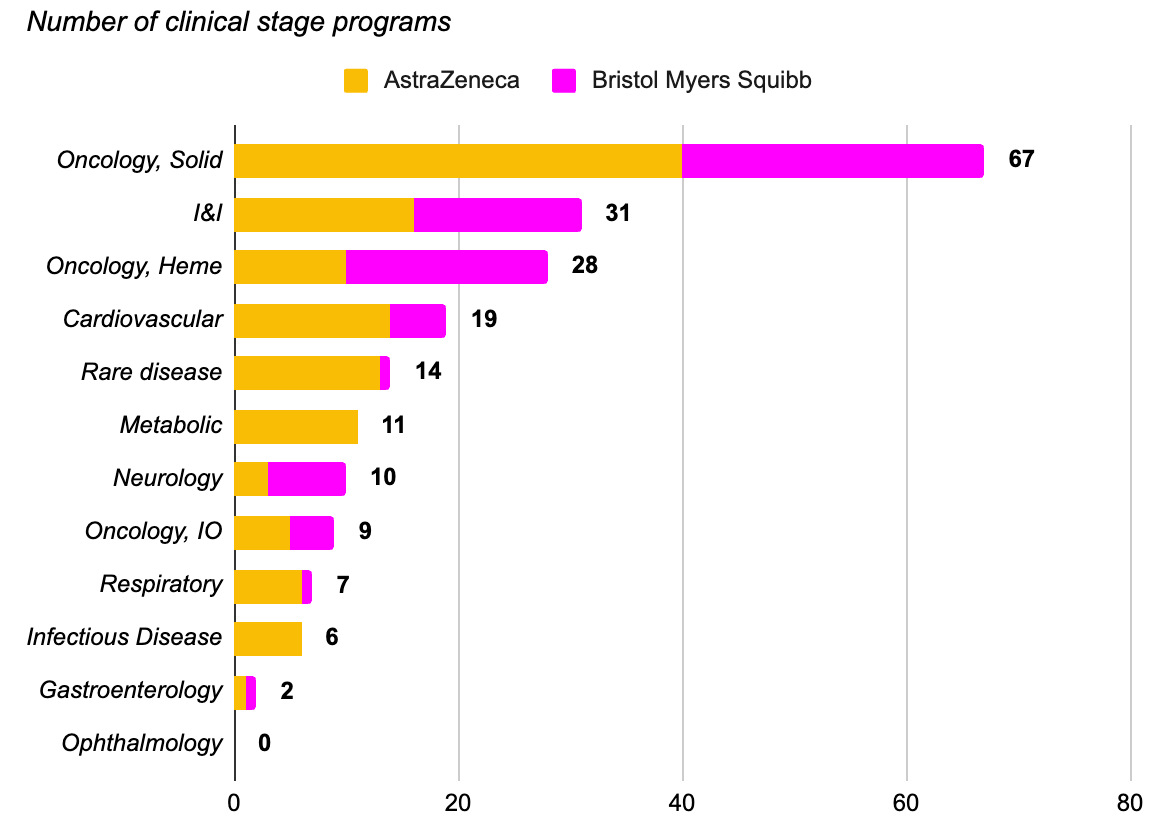
Speaking of the clinical-stage pipeline, the hypothetical merger would result in the near-doubling of programs in the solid tumor, heme tumor, I&I therapeutic, and neurology therapeutic areas.
Conclusion
History shows us that no imperial hegemony, whether built on naval dominance or blockbuster medicines, lasts forever without active reinvention. The AstraZeneca & Bristol Myers Squibb mega-merger may remain a “what-if” footnote in biopharma M&A history, but it serves as a stark reminder of the central challenge of every big pharma CEO: to develop or acquire new & better medicines faster than the older medicines tumble over their patent cliffs, thereby ensuring that the sun never sets on their empire. As key revenue drivers like Eliquis and Opdivo approach their patent cliffs, the industry’s perpetual appetite for new & better medicines won’t diminish. Whether through sweeping cross-border mega-mergers or smaller bolt-on acquisitions, pharmaceutical titans will continue to fortify their Pax Pharmaceutica. After all, in an industry defined by swift generic erosion, standing still is the only guaranteed way to let the sun set on your empire.
Love biotech? Check out Biotech Readout’s full content library, or navigate directly to a segment that interests you:
Frontiers in Medicine: Exploring the frontiers of our understanding and treatments for disease.
Medical History: Recovering forgotten relics in the history of medicine.
Acquisitions: Exploring the innovation behind acquired companies.
Weekly Readout: A digest of new clinical data from the past week.
To contact us, please send us an email at biotechreadout@gmail.com
Disclaimers
Investigational Status Disclaimer
The therapeutic candidates discussed in this newsletter are currently in clinical development and have not been approved for commercial sale by the U.S. Food and Drug Administration (FDA), the European Medicines Agency (EMA), or other global regulatory authorities. Their safety and efficacy have not been established. References to pipeline products and ongoing clinical trials involve significant risks and uncertainties. Statements regarding the potential safety, potency, or efficacy of investigational drugs reflect current hypotheses and are not a guarantee of future performance or regulatory clearance. The outcome of clinical trials is inherently unpredictable, and clinical results from earlier stages may not be predictive of results in later, larger-scale trials.
No Medical Advice Disclaimer
This newsletter is for informational and educational purposes only. The content is not intended to be a substitute for professional medical advice, diagnosis, or treatment. Always seek the advice of your physician or another qualified health provider with any questions you may have regarding a medical condition. Never disregard professional medical advice or delay in seeking it because of something you have read in this publication.
No Patient-Provider Relationship Disclaimer
The information provided in this newsletter is for educational and analytical purposes only. Receipt of this information, or any interaction with this content, does not create a physician-patient, pharmacist-patient, or any other professional-provider relationship between you and the authors or publishers. This newsletter should not be used as a substitute for a personal consultation with a qualified healthcare professional.
Forward-Looking Statements Disclaimer
This newsletter contains “forward-looking statements” regarding future events, including clinical trial timing, regulatory milestones, and projected market performance. These statements are based on current expectations and assumptions that are subject to significant risks and uncertainties. Actual results may differ materially from those expressed or implied. We undertake no obligation to update these statements as a result of new information or future developments.
Third-Party Links & Content Disclaimer
This newsletter contains links to third-party websites, including clinical trial registries and corporate presentations. Biotech Readout does not endorse, guarantee, or assume responsibility for the accuracy or reliability of any information offered by third-party providers.
Errors and Omissions Disclaimer
While we strive for technical accuracy, the information in this newsletter is provided on an “as is” basis with no guarantees of completeness, accuracy, or timeliness. Biotech Readout assumes no liability for any errors or omissions in the content of this publication.
Non-Endorsement Disclaimer
Any reference to specific commercial products, processes, or services by trade name, trademark, or manufacturer does not constitute or imply an endorsement or recommendation by the author. All trademarks are the property of their respective owners.
No Investment Advice Disclaimer
This newsletter is for informational purposes only and does not constitute financial, investment, or legal advice. The author is not a registered investment advisor. You should consult with a professional financial advisor before making any investment decisions. The biotechnology sector is highly volatile; past performance is not indicative of future results.
Conflict of Interest Disclaimer
The author of this newsletter maintains a position of independence. At the time of publication, the author holds no direct financial interest, equity, or options in any of the companies mentioned in this report. No compensation has been received from any third party to feature or analyze specific therapeutic candidates or corporate entities.
Seems like it never existed to begin with