
Jazz to Acquire Actio
How David Goldstein's precision neuroscience thesis hit escape velocity

Disclaimer: This newsletter is for educational and informational purposes only and does not constitute medical, investment, or financial advice, nor does it establish a provider-patient relationship. Content may include forward-looking statements and discussions of investigational therapeutic candidates that are not FDA/EMA approved; their safety and efficacy remain unestablished and clinical outcomes are unpredictable. While we strive for accuracy, all information is provided as is without guarantees. As of the date of publication, the author holds no direct equity positions in the specific companies mentioned in this issue nor receives third-party compensation for this coverage. Please find a complete version of our disclaimers linked here.

If you are a paid subscriber, go to epilepsy landscape here ⬇️
If you are a free reader or subscriber, enjoy the whole article free of charge and consider upgrading for competitive landscapes of disease areas & therapeutics modalities; view samples here.
Introduction
On August 10, 2026, Jazz Pharmaceuticals plc announced a definitive agreement to acquire Actio Biosciences, Inc. for $820 million upfront and up to $500 million in contingent consideration (Jazz press release, Actio press release). This acquisition centers on three investigational pipeline programs:
ABS-1230 (KCNT1 inhibitor for KCNT1+ epilepsy; Phase 1b/2 ongoing): This is Actio’s lead asset and attracted special interest from Jazz, as indicated by its more prominent position in their press release. ABS-1230 is an investigational “potential first-in-class precision therapy for KCNT1+ epilepsy”, according to Jazz. Currently in clinical evaluation in the KYRON Phase 1b/2 trial in pediatric patients (ages 1 month to 21 years) with KCNT1-related epilepsy and received FDA Fast Track, Orphan Drug (ODD), and Rare Pediatric Disease (RPDD) designations.
ABS-0871 (TRPV4 inhibitor for CMT2C & OAB; Phase 1 completed): This is an oral small-molecule inhibitor of TRPV4, a calcium-permeable cation channel. It has completed Phase 1 single- and multiple-ascending dose (SAD/MAD) trials in healthy volunteers and was granted Orphan Drug Designation (ODD) and Rare Pediatric Disease Designation (RPDD) by the FDA for CMT2C.
Unnamed preclinical program (undisclosed mechanism for rare genetic epilepsy or common CNS disorder)
In this article, we dive into the founding story of Actio, expand on its “one to many” thesis, and explore how they generated a clinical dataset that caught the eye of Jazz Pharma.
One to Many
The scientific foundation of Actio stems directly from the work of its CEO and co-founder, Dr. David Goldstein. A world-renowned human geneticist (formerly Director of the Institute for Genomic Medicine at Columbia University and founder of Duke’s Center for Human Genome Variation), Goldstein spent decades pioneering genomic screening methods to identify pathogenic mutations behind rare, severe genetic conditions. While diagnostic genome sequencing became adept at pinning down these rare, severe mutations, Goldstein recognized a recurring gap: identifying the genetic driver rarely translated into an actionable treatment. To bridge this gap from genetics to therapeutics, Goldstein co-founded Actio in 2021 alongside biotech veteran Dr. John McHutchison, former Chief Scientific Officer and Head of R&D at Gilead Sciences.
“I tried to convince a few pharma companies to create rare disease units. That was a complete failure. I spent so many years trying to do that. I just got absolutely nowhere. So I eventually decided if I can’t get someone else to do it, I’ll do it myself”
David Goldstein (CEO of Actio) in a June 2025 interview with Endpoints News
The company’s founding thesis was predicated on a philosophy the founders called “From One to Many”. Actio planned to use rare, genetically defined human diseases as beachhead indications to rapidly prove target modulation before expanding into broader, high-prevalence indications that share the same underlying pathway. In doing so, they hoped to overcome two historic challenges in neuroscience drug discovery: high biological failure rates in common disease trials and limited commercial scale in rare disease programs.
To fit this criteria, Actio selected rare conditions that are driven by highly penetrant, severe gain-of-function (GoF) mutations in a single gene. Since nature has already performed a genetic knock-in experiment of sorts, the target’s role in driving disease physiology already has genetic validation in humans. This is only one piece of the puzzle because the underlying ion channel, receptor, or enzyme needs to be biologically relevant outside of that rare disease in order to theoretically scale from “one to many”. Once the molecule’s safety, potency, and target engagement are proven in the rare population, Actio might be able to expand the asset into more common conditions sharing that same mechanism. Beyond scalability, Actio’s “One to Many” approach had the possibility of improving multiple challenges in neuroscience drug development:
More Translatable Animal Models: Traditional drug discovery often fails in Phase 2 because target hypotheses based on animal models do not translate to human disease biology. In rare GoF monogenic disorders, human patient genetics strongly support target involvement, potentially improving the alignment of translational biomarkers between preclinical models and clinical trials.
Higher Signal-to-Noise Ratio: Genetically homogeneous rare disease cohorts exhibit more consistent phenotypes. This could potentially enable smaller trial sizes, more rapid readout timelines, and less biomarker/clinical endpoints.
Regulatory Tailwinds: Target indications qualify for Orphan Drug (ODD), Fast Track, and Rare Pediatric Disease (RPDD) designations, shortening regulatory review cycles and granting market exclusivity.
To realize their vision, Actio built the Rare Disease Target Atlas, a proprietary platform integrating deep genomic profiling, structural biology, bioinformatics, and medicinal chemistry. The atlas allowed Actio to systematically scan human genetic data, map severe monogenic mutations to specific ion channels or enzymes, and assess their druggability for broader indications.
Securing a Beachhead
Establishing a founding thesis is one thing, but putting a thesis into practice is a whole other thing entirely. History is replete with companies built on a “thesis” or “platform” that raised money for years (sometimes decades), only to close up shop before ever advancing a single pipeline program to clinical proof-of-concept. Actio is not one of those companies. Rather, it was an execution engine that aimed to deliver on the promise of its founding thesis.
Actio Biosciences emerged from stealth in September 2023 with a $55 million Series A financing round co-led by Canaan and Droia Ventures, with participation from Deerfield Management, Euclidean Capital, and EcoR1 Capital (which previously participated in Actio’s $8 million seed funding). To validate its genetic targets and rapidly translate genomic discoveries into preclinically vetted drug candidates, Actio established a strategic research partnership with animal model powerhouse Jackson Laboratory (JAX). A key challenge in rare disease drug development is the lack of animal models that faithfully mirror human gain-of-function mutations. In collaboration with JAX, custom transgenic and CRISPR/Cas9 knock-in rodent strains were deployed to recapitulate pathogenic variants of rare genetic disease in vivo.
At the time, ABS-0871 (TRPV4 inhibitor) was their lead program. TRPV4 encodes a calcium-permeable cation channel expressed across peripheral nerves, chondrocytes, and vascular endothelial cells. Through genomic screening and structural modeling, Actio identified severe pathogenic mutations in TRPV4 as potent gain-of-function (GoF) drivers. In diseases like Charcot-Marie-Tooth Disease Type 2C (CMT2C), these GoF mutations trigger toxic intracellular calcium overload, destroying blood-neural barrier integrity and driving peripheral nerve degeneration. To address this toxicity, Actio engineered ABS-0871, an oral, potent, and highly selective small-molecule TRPV4 channel antagonist. In preclinical models of CMT2C, ABS-0871 demonstrated target inhibition that was associated with reduced cell-barrier breakdown and improvements in preclinical measures of motor and respiratory function. This earned ABS-0871 FDA Fast Track, Orphan Drug, and Rare Pediatric Disease designations. CMT2C was the rare disease, but the scale-up strategy revolved around Overactive Bladder (OAB), in which TRPV4 functions as a crucial mechanosensor in the urothelium and detrusor muscle.
Actio initiated human testing for ABS-0871 as its first-ever clinical-stage asset in early March 2025. The randomized, double-blind, placebo-controlled Phase 1a single- and multiple-ascending dose (SAD/MAD) trial in healthy adult volunteers was designed to evaluate human safety, tolerability, pharmacokinetics (PK), and target engagement (pharmacodynamics). Establishing safety and PK in healthy subjects served as the necessary bridge to launch patient trials in CMT2C and overactive bladder (OAB).
Meanwhile, Actio’s Rare Disease Target Atlas surfaced a second opportunity that fit their thesis. KCNT1-related developmental and epileptic encephalopathy (DEE) is caused by dozens of distinct gain-of-function mutations across the gene, resulting in a high seizure burden and resistance to anti-seizure medications. There are currently no U.S. Food and Drug Administration (FDA) approved therapies for KCNT1+ epilepsy.
KCNT1+ epilepsy is a rare genetic developmental and epileptic encephalopathy (DEE) affecting approximately 2,500 patients in the United States. Patients suffering from KCNT1+ epilepsy typically endure a profound seizure burden, with most experiencing dozens to hundreds of episodes daily that remain highly resistant to antiseizure medications. Approximately 80% of individuals with KCNT1+ epilepsy experience disease onset during infancy; many of these children never achieve fundamental developmental milestones, such as walking or speaking, and tragically, some do not survive into adulthood. For those with later-onset disease, the condition typically manifests as disruptive nocturnal seizures, often accompanied by significant cognitive and psychiatric comorbidities.
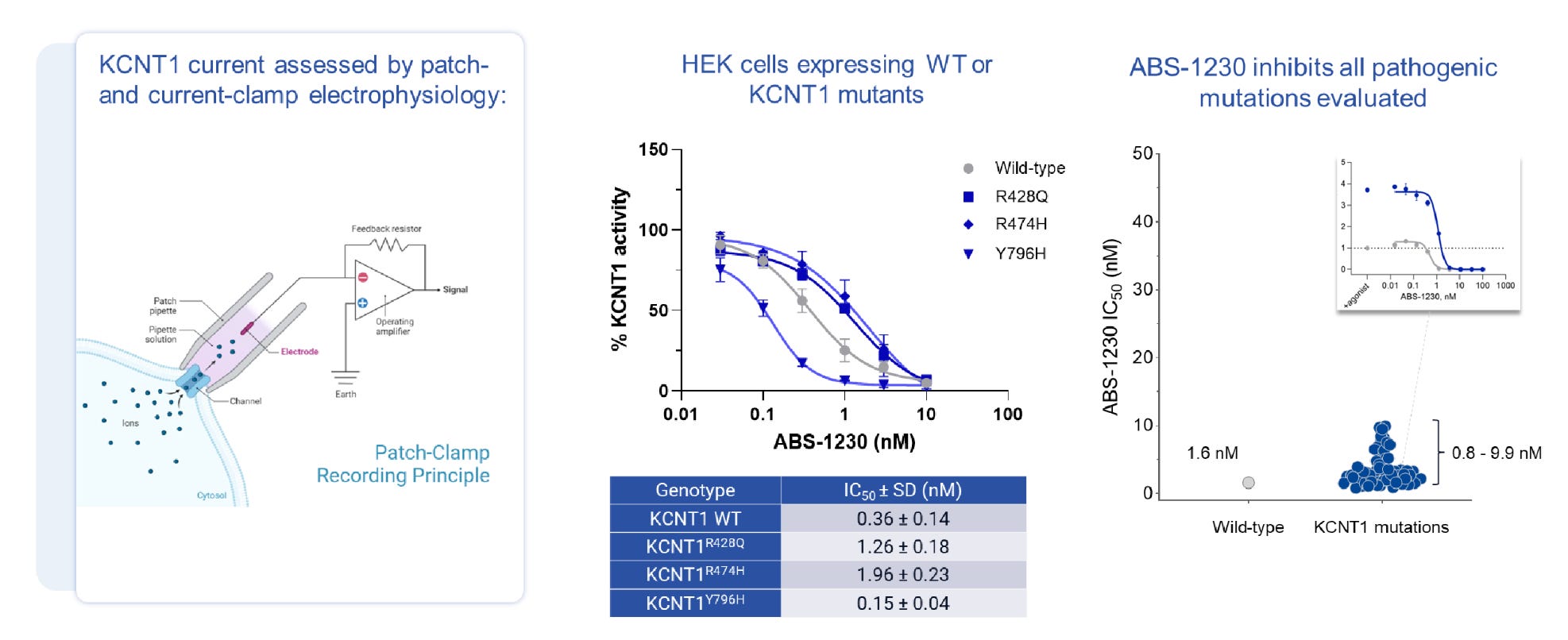
To address this unmet medical need, Actio engineered ABS-1230 as a brain-penetrant small molecule designed to inhibit all tested pathogenic GoF variants with the hopes that the drug would work broadly across the KCNT1 patient population rather than requiring mutation-specific therapies. In HEK293 cells that expressed wild type (WT) or 63 different mutant KCNT1 proteins, ABS-1230 blocked current through the sodium-activated potassium channels with nanomolar potency, as assessed by patch clamp (see graph below). Separate experiments, confirmed that ABS-1230 demonstrated selectivity for KCNT1 and did not significantly inhibit other ion channels (tested 22 potassium channels, 9 sodium channels, 2 calcium channels, 11 other ion channels, >40 GPCRs, and >400 kinases).
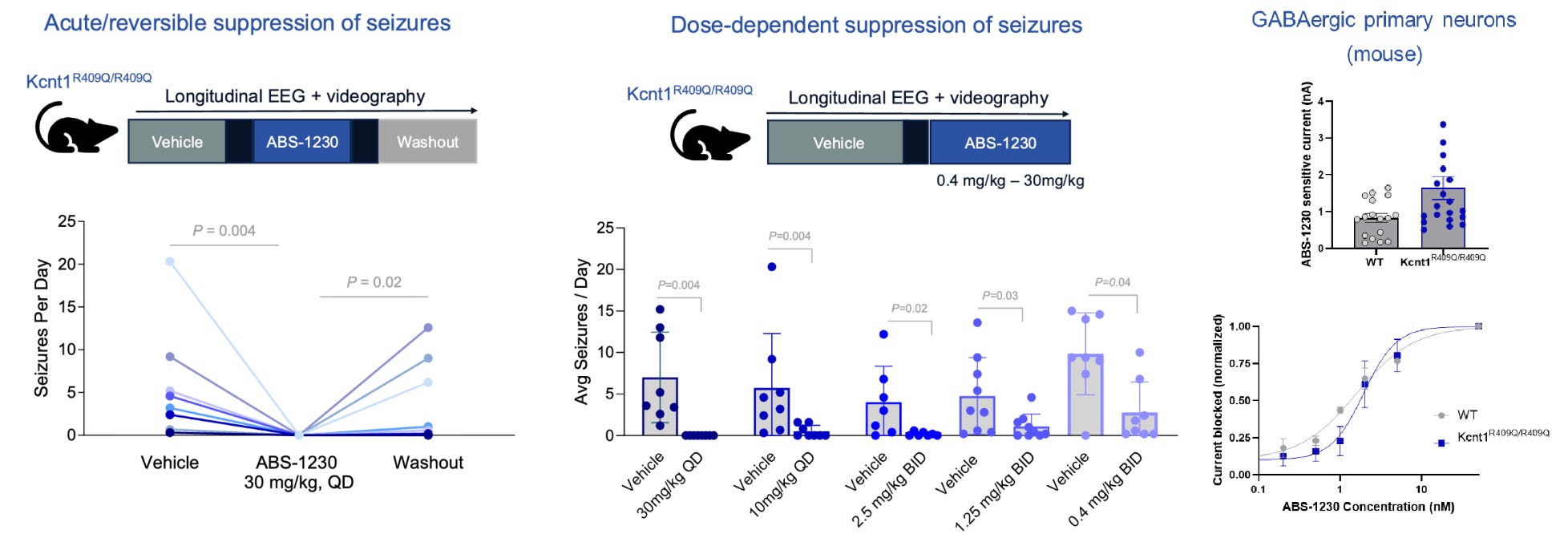
In 8-week-old transgenic mice harboring two KCNT1 mutations (Kcnt1R409Q/R409Q mice), ABS-1230 was shown to suppress spontaneous seizures, with seizures returning after a 14-day washout period (see graph below). Additional patch clamp experiments confirmed that GABAergic neurons isolated from wild-type (WT) and Kcnt1R409Q/R409Q mice were inhibited with nanomolar potency (see graph below). Lastly, ABS-1230 demonstrated high oral bioavailability and CNS penetration in preclinical species. While promising in rare epilepsies bearing KCNT1 mutations, an inhibitor might have broader applicability (true to Actio’s “One to Many” thesis). Hyper-excitable neural networks in common epilepsies often rely on unbalanced potassium and sodium conductance to sustain rapid firing spikes. Therefore, it’s possible that a KCNT1 inhibitor could have utility in broader epilepsy populations (although there isn’t yet any clinical evidence supporting this).
Armed with significant progress in two beachhead programs, Actio Biosciences closed a $66 million Series B financing round in June 2025. The financing was co-led by Regeneron Ventures (a new institutional investor) and returning lead investor Deerfield Management with participation from Canaan, Droia Ventures, and Euclidean Capital. This raise was earmarked to fund clinical execution and “proof-of-concept” readouts across Actio’s two pipeline programs.
Two months later, the FDA cleared Actio’s Investigational New Drug (IND) application for ABS-1230 (KCNT1 inhibitor) and granted it Fast Track, Orphan Drug, and Rare Pediatric Disease designations. Actio dosed the first participant in its Phase 1a SAD/MAD healthy volunteer and food-effect trial in Australia (under combined TGA approval and FDA IND clearance). The trial established that ABS-1230 possessed favorable safety and PK profiles with no serious adverse events. Building on Phase 1a safety data, Actio expanded into the KYRON Phase 1b/2 clinical trial in pediatric and young adult patients (ages 1 month to 21 years) with KCNT1-related epilepsy. According to Jazz, the trial is designed to potentially support a future U.S. New Drug Application (NDA) submission, subject to regulatory agreement and clinical outcomes. The program was also accepted into the FDA’s Rare Disease Evidence Principles (RDEP) process to streamline its path toward potential registration.
Smooth Jazz
While Actio never publicly released data from their KYRON Phase 1b/2 trial, Jazz highlighted in its transaction disclosures that ABS-1230 “demonstrated meaningful seizure reductions in an early clinical proof-of-concept trial in children with KCNT1 epilepsy”. Based on public statements, these preliminary findings likely served as a primary catalyst for the acquisition. Renee Gala, president and CEO of Jazz Pharmaceuticals, commented, “The emerging clinical profile of ABS-1230 is highly encouraging, and we look forward to closing the proposed transaction and collaborating with our new Actio Biosciences colleagues to address an urgent patient need. Together, we are committed to working alongside the epilepsy patient community and regulators to bring this important medicine to children and families, who currently have no treatment options for a devastating disease.”
Jazz is no stranger to neuroscience. Their two blockbuster medicines Xywav (oral oxybate) and Epidiolex (oral canabidiol) are neuro drugs that are approved to treat narcolepsy and seizures, respectively. Actio’s precision neuroscience candidates jive well with Jazz’s pipeline and, if they eventually pass FDA muster after rigorous clinical trials, they could be a good fit for Jazz’s neurology-focused commercial infrastructure. Most importantly, the Jazz-Actio partnership bolsters the effort to develop new therapeutic options for the thousands of patients living with rare epilepsies.
Epilepsy Competitive Landscape
All charts reflect data current as of the specified date and may not include every drug development program, although we aimed to capture the vast majority. Please feel free to email me at biotechreadout@gmail.com with “CHARTS” in the subject line to share suggestions or request chart updates.
Press ⬇️ to navigate to a section
