

Disclaimer: This newsletter is for educational and informational purposes only and does not constitute medical, investment, or financial advice, nor does it establish a provider-patient relationship. Content may include forward-looking statements and discussions of investigational therapeutic candidates that are not FDA/EMA approved; their safety and efficacy remain unestablished and clinical outcomes are unpredictable. While we strive for accuracy, all information is provided as is without guarantees. This newsletter is independent, and the author holds no financial positions in the companies mentioned nor receives third-party compensation for this coverage. Please find a complete version of our disclaimers at the bottom of this article and on our About page.

Introduction
On May 20, 2026, Engage Biologics announced a definitive agreement to be acquired by Eli Lilly and Company for up to $202 million in cash, including an upfront payment and subsequent payments upon achievement of specified development milestones. This acquisition centers on Engage’s Tethosome platform, a novel non-viral DNA delivery system designed to “overcome key limitations in DNA delivery, including potency, tolerability, and redosability.”
Here, we dive into founding journey of Engage Bio and explore how its Tethosome platform could advance the frontier of genetic medicine.
A Founder-led Platform Company
The rapid trajectory of Engage Bio, from its 2021 founding to its $202 million acquisition by Eli Lilly on May 20, 2026, was heavily driven by the distinct, complementary skill sets of its co-founders. Will Olsen (CEO) brought a track record of operational agility, lean startup execution, and clinical project management, while Kathryn Strobel Kwant (CSO) provided the deep, sophisticated protein engineering and drug platform expertise required to invent the Tethosome platform.
Will Olsen graduated with a B.S. in Economics from the University of Florida before shifting toward life sciences, completing a Post-baccalaureate program in Premedical Sciences at Columbia University. He began his career in clinical execution, working as a research associate within the Mount Sinai Health System before moving to Biorasi, a contract research organization (CRO). At Biorasi, he served as a Senior Program Manager, designing and driving clinical programs and managing business development. In 2015, he co-founded and served as Chief Operating Officer (COO) of Luminist Labs, a diagnostic platform aimed at screening for liver disease and early-stage cancer. Luminist was later acquired by DiscernDx, with its technology assets eventually integrated into Viome. From 2019 to 2021, he served as the Vice President of Development Operations at Rejuvenation Technologies, a Stanford University mRNA spinout developing telomere-extending therapeutics. This role solidified his operational mastery of mRNA therapeutics development and manufacturing logistics. In parallel to his operator roles, Olsen joined the Pioneer Fund as a Venture Partner in 2019, giving him insight into early-stage biotech deal-making. His co-founder is equally as impressive.
Kathryn Strobel Kwant completed her Ph.D. in Chemical Engineering at UC Berkeley under the co-direction of pioneering biochemical engineers Harvey Blanch and Douglas S. Clark. Her doctoral research focused on enzyme mechanics, directed evolution, and altering carbohydrate-binding modules to optimize performance and reduce inhibition in complex environments. Before founding Engage Bio, Dr. Kwant was a vital scientific force at Harpoon Therapeutics (acquired by Merck for $650 million in 2024), a company celebrated for pioneering multi-specific T-cell engagers (TCEs). During her tenure, she specialized in designing complex, multi-functional biologics. She was a lead inventor and architect behind TriTAC-XR (an extended-release, trispecific T-cell activating construct) and ProTriTAC (a protease-activatable prodrug platform). These technologies were specifically designed to minimize systemic maximum drug concentration (Cmax) to reduce Cytokine Release Syndrome (CRS) while expanding the therapeutic window for solid tumors. Furthermore, Kwant is a named inventor on numerous foundational biopharmaceutical patents covering conditionally activated target-binding molecules, EpCAM-binding proteins, and trispecific protein constructs for oncology.
The pairing of Olsen and Kwant perfectly mirrored the dual requirements of the Tethosome platform. Olsen’s background at Rejuvenation Technologies provided the operational blueprints for handling lipid nanoparticles (LNPs) and mRNA chemistry. Meanwhile, Kwant’s deep expertise in engineering multi-functional proteins allowed Engage Bio to design the proprietary DNA-binding protein encoded by that mRNA, the vital bridge that shields the therapeutic DNA payload from innate cellular immunity and tethers it within the nucleus for sustained expression.
The founders sought to engineer a solution to the two biggest bottlenecks plaguing non-viral gene therapy:
Nuclear localization: Getting large DNA payloads across the nuclear membrane without a viral vector.
Innate immune sensing: Preventing the cell from detecting and destroying foreign DNA.
Unlike highly capitalized biotech startups that launch with massive Series A rounds and public relations blitzes, Engage Bio operated as an ultra-lean, stealth-mode organization. The company relied on a mix of modest seed capital and highly competitive translational grants. They went through Y Combinator and secured early venture backing from ecosystem micro-VCs and angel networks including SciFounders, Pioneer Fund, and the Cal Innovation Fund.
To advance the science without excessive dilutive equity, Engage Bio secured non-dilutive grants through the National Institutes of Health (NIH) and the Bill & Melinda Gates Foundation. Crucially, they also received financial backing from the Cystic Fibrosis Foundation (CFF), signaling that their delivery platform had potential therapeutic viability in difficult-to-target mucosal tissues like the lungs.
During this period, the team (which later included key RNA scientists like CTO Ben R. Hawley, Ph.D.) quietly developed and patented the Tethosome platform. Instead of relying purely on standard DNA or standard mRNA, they built a dual system: using an LNP to co-deliver a therapeutic DNA payload alongside an mRNA strand that codes for a proprietary DNA-binding protein, enabling the DNA to safely enter and “tether” inside the nucleus for sustained expression.
Engage Bio never publicly disclosed a formal, single pipeline indication or internal drug asset. Instead, they focused entirely on validating the modular nature of the Tethosome platform. This strategy culminated on May 20, 2026, when Eli Lilly and Company announced an agreement to acquire Engage Biologics for up to $202 million in cash. The transaction suggests that Lilly intends to integrate Engage Bio into its broader genetic medicines organization, potentially utilizing the Tethosome platform as a modular, non-viral delivery system for its own expanding portfolio of redosable DNA therapies. It’s a rare moment where a major pharmaceutical player may have gained conviction in a platform’s capabilities, rather than a specific pipeline asset.
The Platform that Olsen & Kwant Built
In the modern era of genetic medicine, the industry has become incredibly proficient at gene editing machinery, the DNA encoding enzymes that can correct the root cause of disease. However, the field continues to stall at the last mile: delivering that code safely, effectively, and repeatedly to the right cells. Historically, introducing foreign DNA into the human body has been a high-stakes gamble. The body’s innate immune sensors often identify these genetic payloads as threats, triggering inflammatory responses that can range from neutralizing the treatment to being outright lethal.
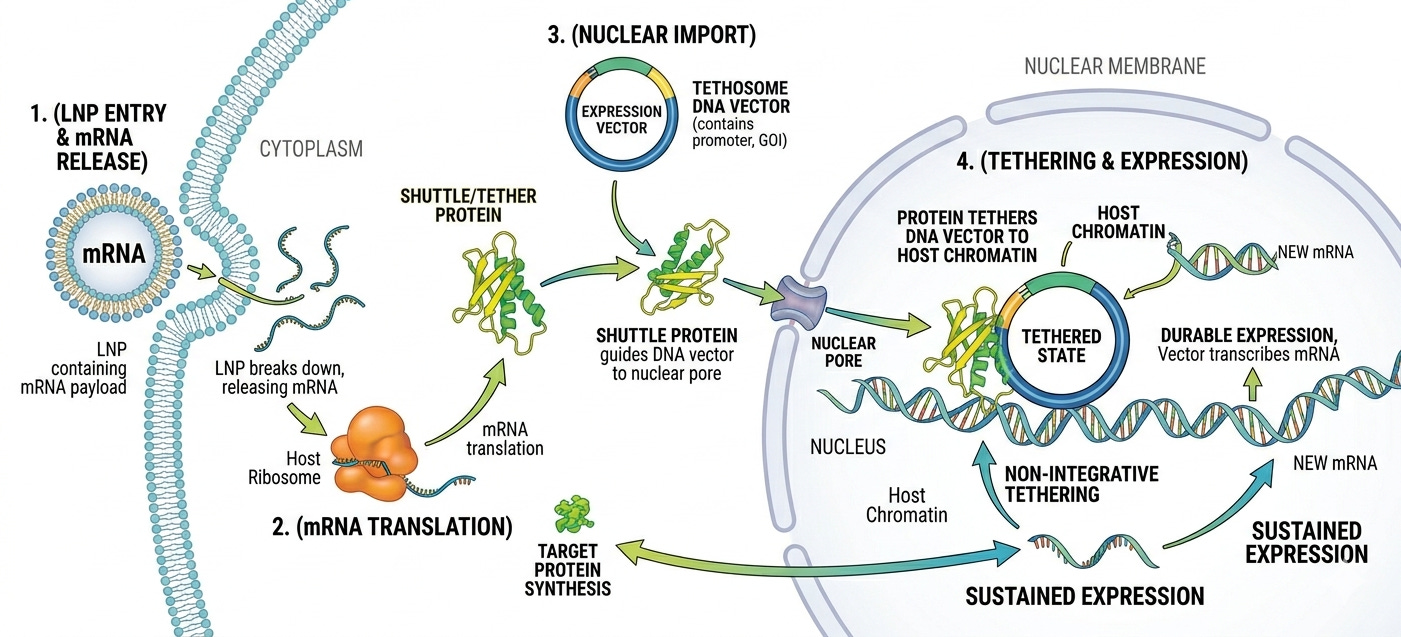
The center of the Engage Bio deal is the Tethosome platform, a technology that seeks to bridge the gap between mRNA’s ease of delivery and DNA’s long-term durability. Unlike traditional methods, the Tethosome system utilizes lipid nanoparticles (LNPs) to co-formulate two distinct components: a recombinant therapeutic DNA expression vector and an mRNA that encodes a proprietary “Tethosome” protein.
The mechanics represent a significant technical leap. Once the LNP enters the cell, the mRNA is translated into a protein intended to both shuttle the DNA payload to the nucleus and ‘tethers’ the expression vector within it. This anchoring mechanism is designed to enable durable expression without the need for the DNA to integrate into the host genome. According to Engage Bio, this dual-action approach results in a 100-fold increase in expression compared to traditional non-viral methods.
The “holy grail” of genetic medicine is redosability, the ability to administer multiple doses to titrate a drug to optimal levels, much like a traditional pill. Viral vectors, specifically adeno-associated virus (AAV), have long been the industry standard, but they are plagued by immunogenicity and cytotoxicity. Once a patient receives an AAV-based therapy, their body often develops antibodies that make redosing impossible, effectively making it a one-and-done treatment with no room for error.
Tethosomes are engineered to be “invisible to immune sensors”, according to Engage Bio. By aiming to avoid the innate immune triggers that typically detect foreign DNA, the platform is designed to potentially allow for safe, repeated administration. This addresses the primary limitations found in previous generations of gene therapy, which often struggled with sometimes lethal immune activation or diminished efficacy over time.
While the official acquisition press release remains high-level, a NCATS grant data reveals two potential areas where Engage Bio is focusing its anchoring technology:
Hemophilia A: A monogenic disease caused by a deficiency in Factor VIII (FVIII). Engage Bio could use Tethosomes to provide a potentially safer, redosable alternative to current AAV therapies, which often suffer from varying expression levels and a lack of redosability.
Liver Cancer (Hepatocellular Carcinoma): The platform could used to deliver a cocktail of clinically validated pro-inflammatory cytokines, specifically IL-15su (sushi) and IL-12sc (single chain), alongside IL-2 and GM-CSF.
A BioSpace article about the acquisition also indicates that the Cystic Fibrosis Foundation (CFF) was a funding source of Engage Bio, suggesting historical research interest or early-stage exploratory alignment with cystic fibrosis.
Conclusion
From an industry perspective, Eli Lilly’s acquisition of Engage Bio represents a highly strategic move within the competitive gene therapy landscape. Buoyed by the unprecedented weight-loss windfall generated by its GLP-1 portfolio, Lilly is utilizing its massive cash flow to in-house and derisk early-stage platform technologies. The pharmaceutical giant had committed nearly $21 billion to M&A activity in the first four months of 2026 alone. As the industry matures, the delivery platform itself may prove to be the most valuable asset in a pharmaceutical portfolio, the gatekeeper to the last mile of gene therapy.
To contact us, please send us an email at biotechreadout@gmail.com
Disclaimers
Investigational Status Disclaimer
The therapeutic candidates discussed in this newsletter are currently in clinical development and have not been approved for commercial sale by the U.S. Food and Drug Administration (FDA), the European Medicines Agency (EMA), or other global regulatory authorities. Their safety and efficacy have not been established. References to pipeline products and ongoing clinical trials involve significant risks and uncertainties. Statements regarding the potential safety, potency, or efficacy of investigational drugs reflect current hypotheses and are not a guarantee of future performance or regulatory clearance. The outcome of clinical trials is inherently unpredictable, and clinical results from earlier stages may not be predictive of results in later, larger-scale trials.
No Medical Advice Disclaimer
This newsletter is for informational and educational purposes only. The content is not intended to be a substitute for professional medical advice, diagnosis, or treatment. Always seek the advice of your physician or another qualified health provider with any questions you may have regarding a medical condition. Never disregard professional medical advice or delay in seeking it because of something you have read in this publication.
No Patient-Provider Relationship Disclaimer
The information provided in this newsletter is for educational and analytical purposes only. Receipt of this information, or any interaction with this content, does not create a physician-patient, pharmacist-patient, or any other professional-provider relationship between you and the authors or publishers. This newsletter should not be used as a substitute for a personal consultation with a qualified healthcare professional.
Forward-Looking Statements Disclaimer
This newsletter contains “forward-looking statements” regarding future events, including clinical trial timing, regulatory milestones, and projected market performance. These statements are based on current expectations and assumptions that are subject to significant risks and uncertainties. Actual results may differ materially from those expressed or implied. We undertake no obligation to update these statements as a result of new information or future developments.
Third-Party Links & Content Disclaimer
This newsletter contains links to third-party websites, including clinical trial registries and corporate presentations. Biotech Readout does not endorse, guarantee, or assume responsibility for the accuracy or reliability of any information offered by third-party providers.
Errors and Omissions Disclaimer
While we strive for technical accuracy, the information in this newsletter is provided on an “as is” basis with no guarantees of completeness, accuracy, or timeliness. Biotech Readout assumes no liability for any errors or omissions in the content of this publication.
Non-Endorsement Disclaimer
Any reference to specific commercial products, processes, or services by trade name, trademark, or manufacturer does not constitute or imply an endorsement or recommendation by the author. All trademarks are the property of their respective owners.
No Investment Advice Disclaimer
This newsletter is for informational purposes only and does not constitute financial, investment, or legal advice. The author is not a registered investment advisor. You should consult with a professional financial advisor before making any investment decisions. The biotechnology sector is highly volatile; past performance is not indicative of future results.
Conflict of Interest Disclaimer
The author of this newsletter maintains a position of independence. At the time of publication, the author holds no direct financial interest, equity, or options in any of the companies mentioned in this report. No compensation has been received from any third party to feature or analyze specific therapeutic candidates or corporate entities.